devotional resources for the week
https://higherthings.org/content/content-reflections/
https://www.lhm.org/dailydevotions/
previous weeks’ devotions
Preparation for Sunday, 10/5
Devotions for 9/29-10/3
Monday
Reading: Luke 17:1-10
“If you had faith like a grain of mustard seed…”
Scripture is constantly referring to faith as a seed. Why? We see in a seed great potential contained in a little thing. So it is with faith. Faith, which appears small, contains within it the potential for great and marvelous things.
Someone once said that “faith agrees.” Faith agrees with God’s word. It’s as simple as that. Faith seems like such a small, little thing. But the fruit that faith will produce is tremendous. “Faith agrees.”
God says “Your sins are forgiven.” Faith agrees. God says “I’m your God.” Faith agrees. God says “You are my dear child.” Faith agrees. Faith is our yes to God’s good commandments and to his life-giving promises.
This “yes” of faith is a small thing, rather like the voice of a little child acknowledging her parents. But through this “yes” God will bring about an abundant crop of love, joy, peace, patience, goodness, kindness, faithfulness, gentleness, and self-control (and more besides).
-BV Return to Daily Prayer page [click here]
Tuesday
Reading: Luke 17:1-10
“It would be better for him if a millstone were hung around his neck and he were cast into the sea than that he should cause one of these little ones to sin.”
Why a millstone? Clearly it’s a heavy object and would be sufficient to pull someone to the bottom of the ocean. But any heavy object would do for that purpose. Why a millstone? Perhaps because a millstone grinds up grains, kernels—seeds. And seeds represent faith.
Someone who “causes one of these little ones to stumble” crushes them, as if under a millstone. Jesus is not referring just to a minor setback but to a catastrophic fall. He is warning us not to crush the faith of others. It would be better for our sin to cast us down alone than that others be crushed along with us.
Apply this message to a father. A father has this wonderful calling to nourish the faith of his children. He gets to see the love of God in them take root, grow, flourish and bear fruit. There is incomparable joy in this calling. But the threats attached to this calling are equally high. Children are vulnerable, and a father can do irreparable harm to the faith of his children if he is only in it for himself. Their potential will never be realized. He is stealing from the future.
So may God give us the courage and strength as fathers and mothers to live in sacrificial love for our children, providing for them, nourishing them, and especially feeding their faith, in church and at home, that it may grow and produce much fruit.
“Beloved, if God so loved us, we also ought to love one another.” (1 John 4:11)
-BV Return to Daily Prayer page [click here]
Wednesday
Reading 2 Timothy 1:1-14
“Follow the pattern of the sound words that you have heard from me, in the faith and love that are in Christ Jesus.”
Another thought about millstones. A millstone travels in a circular motion, getting nowhere. Those who live only for themselves are enslaved to sin, yoked, as it were, to a millstone, getting nowhere, doing Satan’s work for him, in a deathward spiral. “The dog returns to its own vomit, and the sow, after washing herself, returns to wallow in the mire” (2 Peter 2:22). They go around in circles, visiting the same revolting places, indulging the same desires, dissatisfied, but unable or unwilling to break the vicious cycle.
But Christ has broken the cycle. “For freedom Christ has set us free; stand firm therefore, and do not submit again to a yoke of slavery” (Galatians 5:1). There is a new pattern to life, very different from the deathward spiral. This pattern is straight and upward. “Forgetting what lies behind and straining forward to what lies ahead, I press on toward the goal for the prize of the upward call of God in Christ Jesus” (Philippians 3:13-14).
We who are in Christ are united to him in his resurrection and ascension. “Our citizenship is in heaven” (Philippians 3:20). Christ’s power in us raises us above the stagnant filth of our selfish desires and seats us “in the heavenly places in Christ Jesus” (Ephesians 2:6). So, let us “lay aside every weight, and sin which clings so closely, and let us run with endurance the race that is set before us, looking to Jesus, the founder and perfecter of our faith” (Hebrews 12:1-2).
-BV Return to Daily Prayer page [click here]
Thursday
Reading Luke 17:1-10
“So you also, when you have done all that you were commanded, say, ‘We are unworthy servants; we have only done what was our duty.’”
We are in Christ, so we are servants. He took on the form of a servant (Philippians 2) to save us. He is now ascended and seated at the right hand of the Father. But we are Christ’s body, and so we take on that same servant’s form. And we’re unworthy even of this, being called servants of God. “After me is coming one whose sandal strap I am not worthy to untie” (John 1:27).
Christ’s humble service consisted of seeking not his own gain but the benefit of others. He came not to do his own will but the will of his heavenly Father (John 6:38), which was that he die on the cross for our salvation and be raised after three days.
A servant monitors his lord’s will and instructions, not his own. So Christ teaches in the reading that we should be standing not sitting, serving not indulging, attentive to the will of our Master, not distracted by our own desire for pleasure. There is great peace of heart and tranquility of mind for those who, in this way, walk with Christ. “Fear the Lord, you his saints, for those who fear him lack nothing” (Psalm 34:9).
-BV Return to Daily Prayer page [click here]
Friday
Reading Habakkuk 1:1-4; 2:1-4
“I will take my stand at my watchpost and station myself on the tower, and look out to see what he will say to me, and what I will answer concerning my complaint.”
We’re not strangers to the predicament of the prophet. We know that injustice flourishes all around us. The wicked prosper and the righteous are oppressed. We can relate to the prophet’s indignation at the perversion of justice.
There are two ways we can respond. In the first place, we can respond by serving ourselves. An example of this is indulgence of a pernicious cynicism towards the world’s evils and injustices, a cynicism frequently fanned into flame by satire. We turn the brokenness of society into food for our own entertainment, by making fun of those leaders and viewpoints we find disagreeable or harmful.
But God’s gracious will for us is that we respond to evil by serving Him, putting Christ, crucified, risen, and ascended, at the center of our lives. And the primary way we do that is prayer. Take the evils and injustices of a broken society and give them to the Lord in prayer.
“Blessed is the man who walks not in the council of the wicked, not stands in the way of sinners, not sits in the seat of scoffers” (Psalm 1:1). Note the posture. As we saw in the Gospel reading, yesterday, we sit to be served or to serve ourselves. The prophet, however, says “I will take my stand at my watchpost and station myself on the tower, and look out to see what he will say to me.” This is the posture of faith. We stand to attention. We live in vigilant prayer, eyes on God’s word, eyes bent toward heaven, all the time praying “thy will be done, thy kingdom come.”
-BV Return to Daily Prayer page [click here]
Preparation for Sunday, 9/21/25
Devotions for 9/15-9/19
Monday
Reading: Luke 16:14-15
“What is exalted among men is an abomination in the sight of God.”
In these short verses, Jesus points out the fact that human perspective (without faith) is the opposite of God’s perspective. The Pharisees ridicule Jesus for his parable, a parable that seemed to glorify waste and dishonesty (more on the parable later in the week). They put Jesus and his word down. In the arrogance of their minds, they themselves are high and lifted up. And people support their arrogance by praising them to the skies as religious experts. But Jesus rebukes them, reminding them that God’s perspective is the one that counts. And, as God had said to the prophet Samuel centuries earlier, “The Lord sees not as man sees: man looks on the outward appearance, but the Lord looks on the heart” (1 Samuel 16:7).
A change of heart brings a change of perspective. When faith enters us and drives out unbelief, a great reversal happens. Before faith, we see things the way the world sees them. In faith, we see as God sees. And so much depends on how we see things. Despair, anxiety, indifference, arrogance—these attitudes stem from our perspective. So do joy, confidence, and peace.
So keep the faith. When things are going well, don’t forget to pray and give thanks. Don’t let your confidence rest in your own prosperity, skills, or successes. Remember your sin, and repent. And when things aren’t going well, pray with boldness. “Humble yourself in the sight of the Lord and he will raise you up” (James 4:10). Poverty, insults, sickness, injury—these things cannot cast a shadow on a life joined to Christ in his death and resurrection.
-BV
Tuesday
Reading: Amos 8:4-7
“When will the new moon be over, that we may sell grain? And the Sabbath, that we may offer wheat for sale?”
The Amos reading is a lesson in human perspective (without faith). For the recipients of Amos’s message, the Sabbath and the new moon were nothing more than what they appeared to be: a time when you were not allowed to work. Like Ebenezer Scrooge, they judged these holy days based on their utility and found them to be quite useless. They were acting like grown-ups, and so they missed God’s message that resounds through creation.
God placed rest—a holiday—into the fabric of creation (the seventh day). More than merely a cessation of work, the day of rest is a holy day. Through it God teaches us that we receive everything that we need from above, not merely by our own efforts. Even our finest work would come to nothing without God’s blessing. So, keeping a holy-day holy means remembering that we’re babies. We depend on God for everything.
Jesus was crucified because the people he came down to feed refused the meal he offered. They weren’t open to the “bread that comes down from heaven” (John 6:50). They thought they were grown-ups. But his rejection now means life for everyone who hears and answers God’s tender, fatherly voice calling out: “Open up.”
-BV
Wednesday
Reading: Amos 8:4-7
“Hear this, you who trample on the needy and bring the poor of the land to an end…”
“Be fervent in spirit.” (Romans 12:11)
We will be fervent either for the spirit or for the flesh. Amos is directed toward people who are fervent for the things of the flesh. The holy day kindles no spiritual fervor in them. They are bent on worldly gain. It’s the same with the Pharisees who heard Jesus’s parable in the reading from Luke. In all of their fleshly pomp, they ridiculed Jesus rather than clinging to the Word that could have given them true spiritual life.
When Scripture says that “man looks on the outward appearance, but the Lord looks on the heart” (1 Samuel 16:7), it’s the same as saying that man looks on the flesh, but the Lord looks on the spirit. People glorify everything—the status, reputation, social capital, wealth, etc.—that people can cultivate by their own hard work. But from God’s perspective, the only true perspective, what is glorious is what reflects Himself. So, the glory of the spirit is received, while the glory of the flesh is achieved. Thus, St. Paul: “The desires of the flesh are against the spirit, and the desires of the spirit are against the flesh.”
The path of fleshly glory is arduous, toilsome, full of stressors, and it leads to death. But the path of spiritual glory is gentle, and it leads to life. “Come to me, all who labor and are heavy laden, and I will give you rest. Take my yoke upon you, and learn from me, for I am gentle and lowly in heart, and you will find rest for your souls” (Matthew 11:28-29).
-BV
Thursday
Reading: Luke 16:1-15
Jesus commends the steward in the parable for doing what is the opposite of productive, at least from a worldly perspective. From the viewpoint of business, the manager acted wastefully. The goods that were owed to the master did not belong to the manager. Yet he distributed his master’s goods freely by easing his debtors of their burdens. It seems the opposite of productivity.
But the world puts a higher premium on productivity than God does. Or to put it another way, God is not primarily interested in what human beings can produce through commerce, ingenuity and collaboration. God has his eye on what He can produce in man when man becomes a recipient of his goodness.
Here’s one simple way to describe being a recipient of God’s goodness: living in forgiveness. God forgives us through Jesus Christ who died for us, so we also must forgive others. Living in forgiveness feels like an unproductive way to live. In this busy world, who has time to talk things out, admit wrongdoing, and express unconditional love in the words “I forgive you?” On top of that, forgiveness feels plain wasteful. How do I know this person will actually change for the better after I’ve forgiven him? Don’t I need to stay on his case? Make him really feel how in the wrong he was?
No. Living in forgiveness means surrendering my life and the lives of those around me to the Holy Spirit. I must let God produce good things in my neighbor and in myself. “But the fruit of the Spirit is love, joy, peace, patience, kindness, goodness, faithfulness, gentleness, self-control” (Galatians 5:22-23).
-BV
Friday
Reading: Luke 16:1-15
“If then you have not been faithful in the unrighteous wealth, who will entrust to you the true riches? And if you have not been faithful in that which is another’s, who will give you that which is your own?”
We are stewards, which means we don’t own any of what we have in this life. Like the manager in the parable, we are working with what is another’s. Our life, home, food, money, children, land, animals, daily breath—it’s all given by God. And God is not disinterested in what we do with them. We anger Him when we use the breath he’s given us to lie, slander or spread gossip. We anger Him when we squander the time or the money he’s given us for our own amusement. We anger Him when we treat our children like they’re here to please us rather than God. All of us will face judgment on the last day and give an account of what we did with God’s things.
So Jesus invites us to a life of liberality in this parable—not liberality towards what we want, not liberality towards what our kids want or towards what society wants for our kids—liberality toward God. So much anxiety and stress stem from our being chained hand and foot to society’s expectations for what life should look like: sports, house, car, finances, etc. Social ideals are cruel masters.
But God is a gracious master. So relax. Remember that this body and life will return to the dust. What will endure is the one, all-important thing to attend to in this life: the love of Christ. Christ in you is the gift that is never taken away, that belongs to you forever, and that grows without measure or limit.
-BV
preparation for Sunday, 9/14/25
Devotions for 9/7-9/12
Monday 9/8
Reading: Luke 15:1-10
“Rejoice with me, for I have found my sheep that was lost.”
Being lost is generally not a pleasant experience. Picture yourself in a dark forest and you’ve lost the path. Not only are you kicking yourself for losing your way. But you are wracked with doubt as to what to do next. Fear and panic can easily lead you further from the way out. Your burning desire to be home again, though a good desire, drives you on in frantic plunges leading quite possibly toward your own destruction.
This is our condition apart from God. Without God we are lost, far away from the calm of resting in his household. Our minds are scattered to the winds—anxious about past mistakes and worried about the multiplicity of possible futures that could befall us; longing for the ultimate Good but frantically pursuing lesser goods that will turn out to be our own undoing. We look this way and that, and our hearts are restless.
But Jesus came to seek and to save the lost, you and me. He came to get our attention, to call us from all our preoccupations to the one thing needful. “Follow me” Jesus says. “I am the way.” So Jesus leads us back to God. Our hearts find rest in Him: rest from the fear of what’s behind, rest from the anxiety about what lies ahead, rest from our frantic pursuit of lesser goods. We are caught in his steady gaze and held fast by his strong embrace that says: “You are my beloved child. With you I am well-pleased.”
-BV Return to Daily Prayer page [click here]
Tuesday 9/9
Reading: Ezekiel 34:11-24
“For thus says the Lord God: Behold, I, I myself will search for my sheep and will seek them out. As a shepherd seeks out his flock when he is among his sheep that have been scattered, so will I seek out my sheep and I will rescue them from all places where they have been scattered on a day of clouds and thick darkness.”
The nation of Israel was lost at the time Ezekiel was prophesying, about as lost as you could get. Ezekiel saw his prophetic vision in Babylon amidst the exile of the southern kingdom of Judah. Over one hundred years earlier, the northern kingdom of Israel, the other ten tribes, had already been taken into exile by the kingdom of Assyria. While many of the Jews were allowed to return to their homeland after 70 years, no such return took place for the northern tribes. They were dispersed and incorporated into other nations, which highlights the magnitude of the promise God gave through the prophet Ezekiel.
Israel’s story is the story of our soul. When the soul is turned away from God (just as Israel had turned from worshiping God to worshiping idols) it is pulled apart and dissolved. The more the soul moves apart from God, the more it moves towards self-destruction, nonexistence. As the soul’s attention is fixed on lesser goods (or rather, as it mistakes evil for good), it loses its identity, its sense of self. But God is able to pick up the pieces of a shattered existence that appears to be beyond repair. There can and will be a full restoration of identity, purpose, meaning, community—everything that makes us human—through Christ.
-BV Return to Daily Prayer page [click here]
Wednesday 9/10
Reading: Genesis 11:1-9
“So the Lord dispersed them from there over the face of all the earth, and they left off building the city.”“He has scattered the proud in the imagination of their hearts.” (Luke 1:51)
One way to deal with being lost is to pretend as if you weren’t. When we come to Genesis 11, mankind is thoroughly lost, fallen from the paradise they were meant to inhabit. But as the story unfolds, people settle in the valley of Shinar and seek to create their own paradise on earth. “We’ve lost our way,” they say to themselves, “but never fear: we can build our own paradise. We can make a name for ourselves. People will look to us.”
No one likes being lost, but everyone is. It’s uncomfortable to feel afraid of the past and doubtful of the future. It’s unnerving to feel like life is purposeless. Now, we can self-medicate for this like the Shinarians. We can try to dull the pain of having our souls slowly dissolved in empty, aimless wandering. The world is full of things we can subscribe to, sign-up for, practice, invest in, binge etc,—things that give a sense of unity or purpose to our lives. One concrete example: most video games today offer an immersive world-like experience that revolves around the decisions you make and the skills you develop. No more wondering what you should or shouldn’t be doing; the game gives you your purpose. But because these things are not the ultimate Good, they inevitably carry with them a bitter aftertaste. This is a merciful thing, driving us to keep seeking and to keep desiring our true home: paradise, in community with God the highest Good.
-BV Return to Daily Prayer page [click here]
Thursday 9/11
Reading: 1 Timothy 1:5-17
“But I received mercy because I had acted ignorantly in unbelief, and the grace of our Lord overflowed for me with the faith and love that are in Christ Jesus.”
Paul (formerly Saul) was once thoroughly lost: power-hungry, vengeful, hunting God’s people. Imagine if you will: paradise in Genesis is a place called Eden (a word meaning “paradise” or “delight”) from which flowed a river that watered the garden where God placed man to live. Saul is lost, wandering far from Eden, far from the garden watered from Eden, far from any sign of water at all (let’s imagine). Whatever is the opposite of a verdant, lush, fragrant place—that is where Saul was wandering, lost in his own vain ambitions and the imaginations of his heart, convinced he was actually close to God while he was having Christians jailed and executed.
But the grace of God, bubbling up like a fountain, overflowed for Saul. God’s love extended in a life-giving flood of waters that reached even to him, so great His love, so inexhaustible His patient mercy. And it didn’t only wet his toes. Saul drank from the fountain of living water, Christ himself, and then Saul became a spring of living water himself. And God used him as his chosen instrument to give life to the Gentiles by preaching Christ.
Every time we hear God’s word, rightly taught, it’s like a trickle of water in the dry desert. Yes, we are weary and worn with cares, but we have God’s word, and that’s everything. It doesn’t look like much, but that little drink will sustain us. And that trickle, though small and seemingly insignificant, is a path, one we know is leading us upwards to paradise.
-BV Return to Daily Prayer page [click here]
Friday 9/12
Reading: The Lord’s Prayer
“Thy will be done.”
What is it that you want? It’s human to desire things. Desire drives our decision-making and our planning. It shapes the daily rhythms of life.
Now God initially created our desires to be ordered within us. God’s good design is that, first, we would love God above all things. And as it turns out, God loves human beings with an unfading, unconditional love. Loving God above all things naturally entails desiring what God desires, seeking what God seeks. So, it stands to reason that if we loved God above all things, then we would also love our fellow human beings, even more than our own life. So the second principle of ordered desires—you shall love your neighbor as yourself—really flows from the first.
It’s incredibly simple (even if that paragraph just made it sound complicated). Love God. Desire what He desires. Seek after what He seeks after. Will what God wills. That is ordered desire.
Here’s what Luther said about the petition, “thy will be done,” in the Small Catechism. “God’s will is done when He breaks and hinders every evil plan and purpose of the devil, the world, and our sinful nature, which do not want us to hallow God’s name or let His kingdom come.”
Being spiritually lost means having our desires scrambled by the devil, the world and our own sinful flesh. This three-pronged attack drives us toward all kinds of hopes and wants and perceived needs. Then it crashes us into despair, anger and resentment when these desires are not fulfilled. Or when they are fulfilled we embrace a dangerous overconfidence, which will inevitably lead to a yet more disastrous collapse.
Jesus invites us to rest from this futile labor. He invites us to pray, “thy will be done” instead of the constant “my will be done.” Thy will be done in the world. Thy will be done in me. Thy will be done at life’s beginning and at its ending. Rest in simple faith, knowing that God’s will is always best. And His desire is to give us life.
-BV Return to Daily Prayer page [click here]
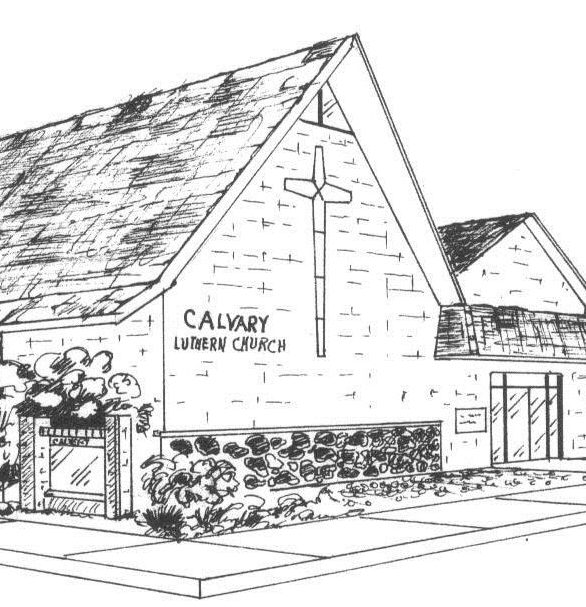
 Calvary Lutheran Church LCMS